
John Rossi: When Olney was a ‘suburb’
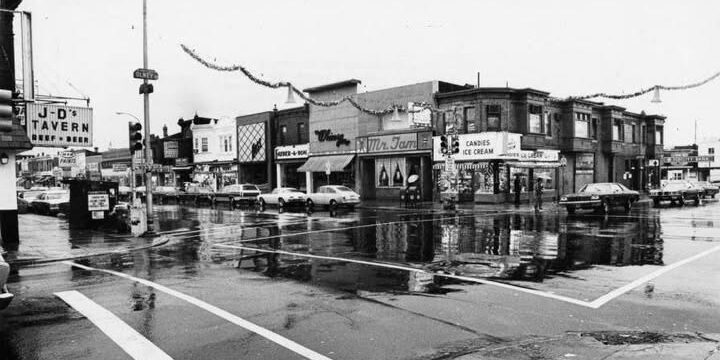
I grew up in the years just after World War II in a pleasant contained place that I call Lower Olney, which I define as: from Roosevelt Boulevard in the South to Olney Ave in the North; from Ninth Street on the West to Front on the East.
Olney was a quiet “suburb” of Philadelphia that had expanded in the 1920s when the Roosevelt Boulevard (named after Teddy not FDR as most people think) opened and the trolley line extended north to Olney Avenue. The population was what we call WASP (white Anglo-Saxon Protestant) with Germans dominating, along with a scattering of Catholic families who started moving into the area in the 1920s, mostly from North Philadelphia, Port Richmond (where my family came from) and Kensington.
During the first fourteen to fifteen years of my life, I hardly left those confines — and confines is the correct word. Venturing outside that area could be dangerous because you were on somebody else’s turf.
Even as a kid, I noticed my part of Lower Olney. It was almost perfectly self-contained and you didn’t have to go beyond your neighborhood. Everything you needed was there. My part of Lower Olney had everything you needed. There was a High School, Olney High, although most Catholics in my time took the bus to North Catholic. There were two grammar schools within walking distance from my house on the 200 block of W. Ruscomb Street: Incarnation of Our Lord (Inky), where I went, and Morrison which was diagonally across 4th Street. The two schools let out at different times probably to avoid any conflict although I never remember any problems like that — a few minor scrapes but no religious baiting
There were three movie houses on Fifth Street: the Lindley, the Colony at Fifth and Olney Avenue — which usually showed double features (that’s two films for the price of one, for movie fans today) — and the Fern Rock near Godfrey Avenue, all within easy walking distance. If you were daring, you could cross the Boulevard and go to the Felton, the main theater in Feltonville.
There were two butcher shops in my immediate neighborhood. My family shopped around the corner at one run by a thin, little man with an unforgettable name: Grover Cleveland Troutwine.
There were four pharmacies nearby: two were Jewish, one was Armenian, and one was Italian, but interestingly enough, Protestant Italians, something I found strange. All the Italians I knew were Catholics. My family patronized Lindenbaum’s at Fifth and the Boulevard. Dr. Lindenbaum, everyone called him ‘Doc,’ was more than a pharmacist. People consulted with him for minor ailments like a family doctor, he sold hair and shaving product and the best black-and-white milkshakes in the area. He was a kindly man, the kind you might drop in just to talk to.
There were a couple of what we called grocery stores — mini markets of a kind. Mine was Steinberg’s. My family did their basic food shopping there, since no supermarket opened in Olney as I remember until the early 1960s. If I needed anything for lunch on my way home from school, I would order it and tell Mr. Steinberg “To put it on the bill,” which my aunt paid every week. Try that at Giant today!
There were two barbershops; one German, the other Italian; but the only hairdresser was Jewish. The two bakeries were German. The son of one was my age but wasn’t allowed to play ball with us because he had to work at the store. He wasn’t allowed to play with us but would hang around and watch us when he was making deliveries. He later hanged himself which made a deep impression on us. It was something we couldn’t understand.
The two shoemakers were German. The one I used had a son slightly older than me and was always at odds with his father which I couldn’t understand as he seemed like a nice kid. When the father heard that I was going to go college, I got a lecture on working hard and making something of myself “unlike that bum of a son I got.”
My local “candy store” was called Mayer’s. The owner was sourpuss who always told you ‘C’mon, hurry up’ when you were staring into the glass candy counter before making your crucial choice. And yes, most of the candy was a penny while the wrapped bars like Hershey’s, Good and Plenty, or Mars Bars were a nickel. He also sold ice cream, magazines and would even make you a milk shake but unlike Dr. Lindenbaum’s, his were thin and weak. Every evening around 7, I would be sent by my uncle to get a copy of the bulldog edition of the Inquirer. I remember the paper had some complete and partial baseball scores on the bottom left of the front page.
There was one Chinese person in the neighborhood, Sam Lee, who had a shop on Fifth Street where he did shirts and sheets. He did a thriving business perhaps because he charged 25 cents for washing and ironing a shirt. I used to take my Uncle’s shirts to him, that’s how I remember the price. As to blacks, there were just two. A pants presser who worked for Sam’s Tailor shop down the corner from me. You hardly ever saw him. He kept to himself and came and went very quietly. I never knew his name. The other black man was our mailman, Herman, who served our street for 20 years. He was a vet, had graduated from college and was popular due his friendliness and getting the mail out on time, especially those Social Security checks.
One aspect of that time, at least in my Olney, was the popularity of the local bars. There were four within easy walking distance of where I lived; three on Fifth Street and one at Second and the Boulevard, all with easy access to public transportation. The most popular, Bowen’s, in the middle of the 4900 block of Fifth Street, served good food and always had some kind of special going—shot and half of whiskey for single price and more beer on tap than any other bar. I later found out that all the beer was Budweiser no matter what the tap said. Michelob was the real deal because even beer drinkers could tell the difference. It also cost 10 cents more a glass.
A by-product of the bars was something you don’t see today, outside of an Eagles game—public drunks. My street had five, all good, hardworking men who ended their day of work at their favorite local. They were serious drinkers. I guess they were what we call ‘functioning alcoholic’ because they all held full-time jobs. Two stand out in my memory. One held a white-collar job and couldn’t hold his liquor. A common sight was Mr. B (I will call him) coming down the street after work, weaving from side to side, clutching his brief case tightly. He often fell into the hedges. We would stop our game of stick ball or touch football, pick him up and carry home, opening his front door (doors weren’t locked back then) and call out to his wife: “Mrs. B we got Mr. B!”
Another one, who worked for Kelly Brickworks, was a short, powerful man who ended his day at Bowen’s. When he saw us playing, he would insist on getting in the game. We would let him until he fell down or lost interest which didn’t take long. It amazed me that he could throw a football further than any of us. His wife, a large red-faced Irish woman, usually would come and take him home.
Nobody thought too much about this. I certainly didn’t as my grandfather had a drinking problem, although a more discreet version. In fact, all were good-hearted and friendly when they were sober, good family men as far as I could tell and certainly regular church goers. I would see them at Mass every Sunday.
What I am describing, I guess would be a ghetto and that is probably correct. If it was, it was a warm and comforting one and one that made growing up a pleasure as well as leaving me with many good memories.
John P. Rossi is a retired History Professor at La Salle University.
I grew up on North Philadelphia three blocks from Connie Mack Stadium and 22nd Street from Lehigh to Allegheny was our business district just like 5th Steet was yours. I have a heart-felt connection to Olney, however. All my buddies from my North Philly neighborhood went to Cardinal Doughtery High School as did my older brother. I was one of those guys who got into LaSalle College High School and became a “Brothers Boy.” Because all of my friends went to CD I spent a lot of time in Olney. My first wife (a CD girl) lived near 2nd & Fern Streets. We had an apartment near 3rd & Grange Streets, then bought a house on Kenilworth right across from CD. My best friend and his wife lived around the corner from the Fern Rock movie theater. My second (and current) wife grew up near 5th & Rockland, went to Inky and then graduated from CD as well. Lot’s a great memories from my years spent chasing girls and living life in Olney.
P.S. Doctor Rossi, I had you for history when I went to LaSalle College in the late 60s.
John: I grew up in your neighborhood on the 200 block of Duncannon avenue went to Inky then CD. My grandparents lived there while my dad was away with George Patton. As the middle child of 8 I remember many of the events you mentioned as my dad was one of the drinkers who mentioned and never missed a days work. Although I missed out on having the kind of dad you would want I always understood the wounds of the war. He never drank prior to the war and was 28 when he went over seas in 42. Several members of my family attended LaSalle. I found growing up in Olney a blessing especially my days going down the Incarnation Club. I recently read a book called “ tell them I’m not home” by Pete Byrne. I loved it and laughed quite a lot when reading. I was very familiar with all he wrote about Olney. I’m guessing you read the book but if not I recommend reading. Ruscomb st had many families I’m familiar with and I believe they have reunions to this day.
Thanks for your note Pete Byrnewas my cousin Guess where he got the idea for his book Unfortunately he died a couple of years ago We had a lot of good times together