
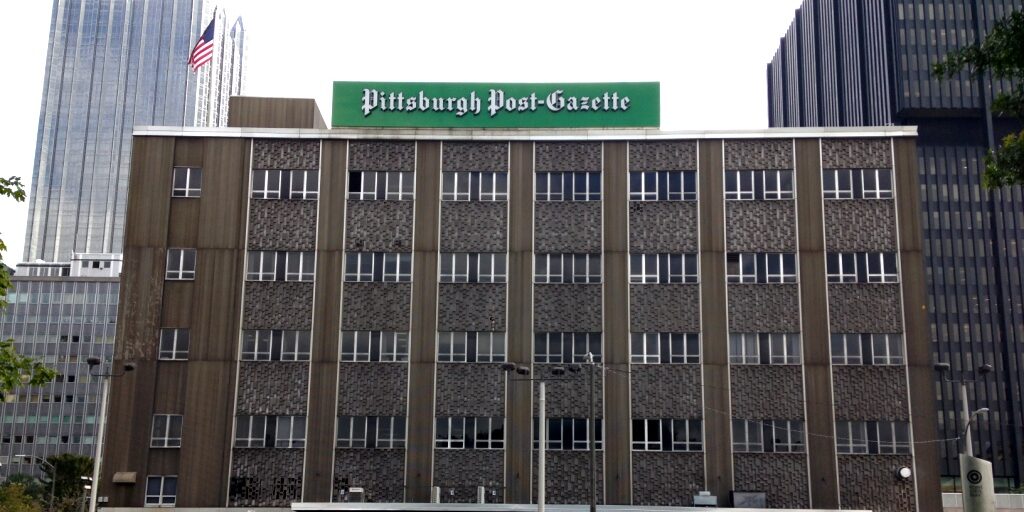
Jon Delano: The demise of the Post-Gazette
In southwestern Pennsylvania, most people have had a love-hate relationship with the Pittsburgh Post-Gazette, the 240-year-old newspaper that abruptly announced the end of its long-term affair with the residents of this region, effective May 3.
In the days since the rather impersonal videotaped announcement to employees, dozens of writers and commentators have both excoriated and sympathized with the demise of a newspaper whose byline proclaims itself, “One of America’s Great Newspapers.”
Block Communications, the Toledo-based ownership, blames the closure on its Pulitzer Prize-winning employees who endured years without pay raises and ultimately went on strike until the courts ruled against the Blocks, all of which makes the company’s claim to terminate the paper “with their dignity intact” rather surreal.
I’ll let others closer to the operation discern whether the striking employees themselves, corporate mismanagement with millions spent on union-busting, changing markets and audiences for newspapers, or just plain spite at losing court battles caused the closure of the Post-Gazette, a local fixture since 1786.
However you slice and dice it, it is a loss for Pennsylvania’s second largest city and a region that makes or breaks the Commonwealth’s politicians in statewide elections – and, thus, heavily dependent on accurate, fact-based news coverage.
As a television journalist covering government, politics, and business for over 30 years, I have had great relationships with many of the PG’s political reporters, some of the best in Pennsylvania. For years, my former employer (KDKA-TV) had a rather one-sided partnership with the PG, where we sponsored a weekly Sunday morning TV show that I occasionally hosted called the “KD/PG Sunday Edition.”
Former PG editors John Craig and later David Shribman would join us in questioning local leaders and offer their often-insightful views, and I would provide political analysis to any PG reporter who called during the week. The paper withdrew from that program in recent years, which I felt was a loss for both entities.
My personal relationship with the Post-Gazette began in the early 1960s when I was a substitute paperboy for my buddy who felt the urge to sleep in on some mornings. I would get up around 5 am, walk to his house up the street, retrieve the bundled pack of newspapers, fold them in the always appropriate way for tossing to doors, and then cross Washington Road with the papers in a large canvas bag to my assigned neighborhood.
The reward came when I had to go door-to-door to subscribers to collect the weekly payment in exchange for a thumbnail piece of paper that reflected payment. Of course, it was the tip I really cared about. As you can imagine, I learned a lot about people during these exchanges.
But those personal experiences are nothing compared to the importance of having multiple sources of news of which the morning Post-Gazette and the evening Pittsburgh Press were important contributors until the PG bought the Press in late 1992. That was about the time that Richard Mellon Scaife, who owned the Greensburg Tribune Review, decided to compete in Pittsburgh with the Pittsburgh Tribune Review, a valuable contribution to our local news coverage.
Like the PG, the Trib had some outstanding reporters, especially in state and local politics, and I read the news sections of both papers religiously. More importantly, a region of over 2.1 million people had two major newspapers and many smaller ones that offered generally fair news coverage.
Both the PG and Trib had great journalists, but, no surprise, their editorial pages differed substantially.
In the early 21st century, almost everyone called the PG the “liberal” paper while the Trib was the “conservative” one. When Scaife’s died in 2014 and John Robinson Block, a grandson of Paul Block who bought the PG in 1927, took control of his paper, the roles seemed to reverse with the PG being perceived as the conservative paper to the Trib’s more moderate stance.
Regardless of its politics, the loss of the PG’s top-notch news journalists will hurt. For the moment, Pittsburgh is left without a major newspaper focused on Pittsburgh. Sadly, in recent years the Trib has pulled back from covering Pittsburgh in the comprehensive way it did under Scaife, and there is no indication it will step in to fill the gap.
This means that Pittsburgh will become America’s largest city without either a daily printed or digital newspaper.
While the region has other daily newspapers – the Beaver County Times, Butler Eagle, and Observer-Reporter quickly come to mind – none purports to cover Pittsburgh or Allegheny County. And the specialized weekly newspapers like the Pittsburgh Business Times and the New Pittsburgh Courier have a unique focus.
I have a copy of the Pittsburgh Post-Gazette from a Saturday morning in 1936 when the PG celebrated its 150th anniversary with messages of congratulations to publisher Paul Block (1875-1941) who founded Block Communications in 1900. One message came from a former owner, George S. Oliver, who wrote, “A newspaper exemplifies eternal youth, born anew each day and forever young.”
Few people believe that today.
Newspapers seem old, antiquated, and out-of-date even when “news” is digitally delivered instantaneously. We’re told 3,200 newspapers have ceased publication in the last 20 years, and Pittsburgh will soon join other “newspaper deserts” spreading across America.
To “save” newspapers often seems to require a compact with the devil. Billionaire oligarchs buy newspapers (and other forms of media) and then influence the news coverage to promote their corporate interests or suck up to government officials.
I will miss the Post-Gazette, especially its quality journalists and photographers with whom I enjoyed covering stories. While one of America’s great newspapers won’t be the last to fold — we still have 938 daily newspapers in the USA — it will force citizens to find other sources of information.
Don’t look to local radio and television to replace the PG. While broadcast media delivers news, sound, and images quickly to more people, a 75-second news hit on TV cannot replace the comprehensive written report and analysis found in most newspapers.
I am not optimistic about what replaces our local newspapers, but I am certain that we in western Pennsylvania are smart enough to find the alternatives that will keep us informed. Heaven help us if we don’t.
Jon Delano is a political analyst, lawyer, and adjunct professor who recently retired from 30 years on television as KDKA-TV’s money & politics editor and 25 years as an adjunct professor of public policy at Carnegie Mellon University’s Heinz College.

Not familiar with the Post Gazette
One can only hope the final days are near for the left wing, TDS afflicted Phila Inquirer.
That day will be a blessing