
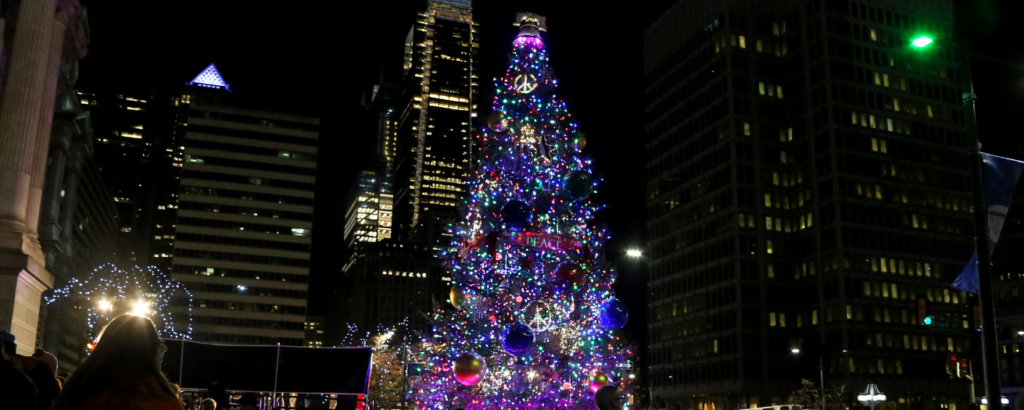
 Photo by City of Philadelphia
Thom Nickels: What kind of tree? The city won’t say.
Shame on the City of Philadelphia!
As the Washington Examiner noted: “It’s December again in the United States, and that can mean only one thing: Philadelphia Democrats’ resumption of the war on Christmas.”
In 2025, Philadelphia continues to remove the word “Christmas” from the city’s annual tree lighting ceremonies, despite the fact that the Democrats in Philadelphia promote diversity, equity, and inclusion.
“Welcome to our mayor’s annual holiday tree lighting program, here at City Hall,” said the city’s director of special events, Jazelle Jones.
The Examiner went on:
“It’s as if the Democrats running the city fear there will be some sort of left-wing uprising if the Christmas tree is actually acknowledged and referred to as a Christmas tree. It’s indicative of the toxic corrosiveness of contemporary left-wing politicians, administrators, officials, and government executives. It is absolutely senseless and completely illogical. I know it’s a Christmas tree. They know it’s a Christmas tree. Everyone in attendance knows it’s a Christmas tree.”
In 2014, when the City of Philadelphia called the 65-foot-tall spruce decorated with 4,000 LED lights and 50 ornaments on the north side of City Hall a “Holiday Tree,” I shook my head in disbelief. From that moment on the tree lighting ceremony in City Hall was more “Christmas neutral” than the tree lighting ceremonies years past. Accompanying music in 2018 included “Let it Snow,” but in 2017 or 2016 it was “Hark the herald angels sing.”
What happened?
Several years ago, the Museum of Art began calling their annual tree a “Holiday Tree,” and nobody raised a voice in protest. The use of the word “holiday,” of course raises the question: which holiday? But how can one answer that if one is not allowed to call the holiday by name, which of course is Christmas. “Holiday” in its most generic, wide umbrella definition might be said to include all holidays celebrated at that time: Hanukkah, as well as the new kid on the block, Kwanzaa.
But Hanukkah and Kwanzaa already have their special symbols and in fact they are always called by their true names. Say it loud and say it proud! It is only Christmas that is still being denuded and stripped of its special character and birthright name. But here’s the rub: You mention anything about an assault on Christmas and often you are regarded as a fanatical Christian white supremacist.
Words are important. Names are important. Often when you change the name of something, you change its meaning. Case in point: In 2010, under the banner of religious diversity, the word “Christmas” was removed from the signs at the annual holiday market on Dilworth Plaza. Amid protests and cries of foul play, Mayor Michael Nutter wisely reinstated the Christmas signs in 2013. Today the remarkable traditional German Christmas Market with its 60-plus vendors, heavily decorated booths, holiday gifts and food is a site not to be missed.
Philadelphia’s Christmas Tree became a “Holiday Tree” in 2014. Mayor Kenney was elected in 2015 and put a seal of wax on the enshrinement of the word “holiday.” There was no going back. On the national front, President Obama, in his last year in office (2016), announced that the White House Christmas Tree would be called a “Holiday Tree” and that religious themed ornaments were on the forbidden list.
President Trump, to his credit, has reversed this trend in spades. During his first administration there were probably more Christmas trees in the White House than at any time in history.
Why all the fuss about Christmas trees anyway? After all, December 25th is listed as a federal holiday: Christmas Day.
The National Christmas Tree in Washington has been called a Christmas Tree since the tradition began in 1923. However, there’s the story of another Christmas Tree on the West Lawn of the U.S. Capitol that was always known as the “Capitol Christmas Tree” until the late 1990s, when that name was changed to “Holiday Tree.” In 2014, House Speaker J. Dennis Hastert changed the name back to the “Capitol Christmas Tree.” At that time The Washington Times reported that, “The speaker believes a Christmas tree is a Christmas tree, and it is as simple as that.”
The newspaper also reported that the Capitol tree was renamed a “holiday tree” in an effort to acknowledge the other holidays of Kwanzaa and Hanukkah — “although no one seemed to know exactly when the name was changed or by whom. “
Insidious interlopers!
It’s no myth that calling a Christmas tree a Christmas tree is still a politically charged prospect in cities and towns across the country.
In Philadelphia’s sister city, Boston, religious diversity operatives (The Department of Parks and Recreation) renamed that city’s giant Christmas tree on the Boston Common a “holiday tree” in 2005, and all hell broke loose. Leave it to those tea-bagger Bostonians to take a stand, unlike, say, Philadelphians, who don’t seem to care (I say seem because there’s always hope) a whit about who renames their annual tree or even what name it’s given.
The Harvard Crimson reported then that the announcement not only sparked controversy over the role of religion in municipal holiday celebrations, but it got the attention of then Boston Mayor Thomas Menino, who objected to the change enacted by the Department of Parks and Recreation. Menino said that he would continue to call the Nova Scotia spruce a “Christmas tree” regardless of the name change, and added: “I grew up with a Christmas tree, I’m going to stay with a Christmas tree.”
Harvard’s Christian community also got into the act, calling the name ‘holiday tree’ ridiculous and maintaining that December 25 is “not some general feel-good day of celebration.” Others chimed in and stated that the name change did not advance the goal of inclusivity.
If only Philadelphia had a mayor who wasn’t afraid to stand up to the woke cancer.
Ironically, the best comment regarding the 2005 Boston tree came from the Nova Scotia logger who cut the tree down in the first place. The Crimson reported:
“Donnie Hatt, who felled the 48-foot tree was also upset about the name change, saying that he would not have cut down the tree had he known it was not going to be called a ‘Christmas tree.’”
“I’d have cut it down and put it through the chipper,” Hatt told the Halifax Herald. “If they decide it should be a holiday tree, I’ll tell them to send it back. If it was a holiday tree, you might as well put it up at Easter.”
I should note that in 2025, the City of Boston hasn’t changed its tune as far as Christmas goes. Boston is every bit as Democrat and left wing as Philadelphia, and yet earlier this month it proudly announced:
“Boston’s official 2025 Christmas tree from Nova Scotia will be lit at the close of a two-hour celebration beginning at 6 p.m. and broadcast live on WCVB Channel 5 starting at 7 p.m. This is the 54th year that a tree has been donated by Nova Scotia and commemorates 108 years of friendship with the people of Boston. The tree will be lit at approximately 7:55 p.m.”
In Philadelphia, it’s never too late to get the name “Holiday Tree” changed back to “Christmas Tree.” If it can happen in Boston, it can happen in Philadelphia. But for this to occur it’s going to take some effort on the part of city residents to stop feeling apathetic or embarrassed about the name.
Thom Nickels is a Broad + Liberty’s Editor at Large for Arts and Culture and the 2005 recipient of the AIA Lewis Mumford Award for Architectural Journalism. He writes for City Journal, New York, and Frontpage Magazine. Thom Nickels is the author of fifteen books, including “Literary Philadelphia” and ”From Mother Divine to the Corner Swami: Religious Cults in Philadelphia.” His latest is “Death in Philadelphia: The Murder of Kimberly Ernest.” He is currently at work on “The Last Romanian Princess and Her World Legacy,” about the life of Princess Ileana of Romania.
It is called “Christmas” and not “Plain Vanilla Holiday” for a reason and calling it “holiday” is an expression of contempt and cultural misapplication. Since they can’t express their bigotry openly for Christmas they use subtle means such as degrading the name of the holiday. If the leftist bozos in Philadelphia government really cared about “inclusiveness” they would name all holidays as per the suggestion of George Costanza’s father and have a universal holiday called “Festiva.”
In 1982, Daniel O’Keefe wrote a book, Stolen Lightning: The Social Theory of Magic, that deals with idiosyncratic ritual and its social significance, a theme relevant to Festivus tradition.
Frank: Many Christmases ago, I went to buy a doll for my son. I reached for the last one they had, but so did another man. As I rained blows upon him, I realized there had to be another way.
Kramer: What happened to the doll?
Frank: It was destroyed. But out of that a new holiday was born. A Festivus for the rest of us.
Welcome to the Airing of Grievances. Next will be the Feats of Strength.
Bravo! Everyone knows the West Cape May “Christmas” Community Parade in South Jersey is a more popular tourist attraction than the Fourth of July fireworks.Why? Because during the last 56 years it’s been called a CHRISTMAS Parade. While other Towns dropped that offending Harold we marched to it, defying conventional feel good “inclusiveness”wisdom from the left. There have been complaints, but it has remained the Christmas Parade with Religious floats and songs. Other Towns took notice. Now lo and behold we all have Christmas parades. Merry Christmas, Thom!