Beth Ann Rosica: Bipartisan phone-free schools bill aims to improve learning and mental health
The Pennsylvania Senate Education committee unanimously passed a phone-free schools bill last week that will require school districts to prohibit the use of mobile devices during the school day. Similar bipartisan legislation has already been enacted in many states, including Arkansas, Arizona, California, Colorado, Florida, Indiana, Louisiana, Minnesota, New York, North Dakota, Ohio, South Carolina, Utah, Virginia, and West Virginia.
The move to eliminate cell phones in Pennsylvania schools gained traction last year with the publication of Jonathan Haidt’s ground-breaking book, The Anxious Generation. The author makes the case that mobile devices have significantly contributed to the adolescent mental health crisis.
Senator Devlin Robinson, a Republican representing parts of Allegheny County, is the prime sponsor of Senate Bill 1014.
The bill, if passed, requires school districts to adopt a policy related to mobile devices by the 2027-2028 school year. The policy must prohibit the use of cell phones and other devices during the school day; although there are allowable exceptions related to medical conditions and other specific exceptionalities.
Senator Devlin is optimistic the bill will pass the full Senate based on its bipartisan support.
“The feedback I’ve received on this legislation from my colleagues in the General Assembly has been overwhelmingly positive,” said Senator Devlin in a request for comment. “In the Education Committee last week, the bill received a unanimous vote; it has nine Republican cosponsors, twelve democratic cosponsors, and I believe there’s a movement in the House to take this up. This is a bipartisan and bicameral issue, so I’m optimistic it will continue to move forward.”
Democratic Senator Steve Santarsiero, representing parts of Bucks County, is one of the bill’s cosponsors.
“I am proud that this bill has bipartisan cosponsors — Republican Senator Devlin Robinson and Democratic Senator Vincent Hughes,” said Senator Santarsiero. “This has been a bipartisan bill from the outset and passed the Senate Education Committee with unanimous support on December 9th. I am confident that this bill will continue to gain support in the Senate from members on both sides of the aisle and I am hopeful that it will reach the Governor’s desk this legislative session. My office, as well as the offices of Senators Robinson and Hughes, are working tirelessly to promote the bill and gather support for it. I have a page on my website with more information as well as a petition folks can sign to show their support for cell phone-free schools.”
The importance of the bill cannot be understated. Our children are literally slaves to their phones, and these devices have significantly contributed to the adolescent mental health crisis in our country.
In The Anxious Generation, Haidt explains the dramatic consequences for our young people as a result of prolonged cell phone use.
“Between 2010 and 2015, the social lives of American teens moved largely onto smartphones with continuous access to social media, online video games, and other internet-based activities,” wrote Haidt. “This Great Rewiring of Childhood, I argue, is the single largest reason for the tidal wave of adolescent mental illness that began in the early 2010’s.”
While eliminating cell phones in school will not “cure” the mental health epidemic, it will certainly improve many aspects of the school day.
Academic performance can only increase when the distraction of mobile devices is removed from instructional time. The 2025 state standardized testing results show that only 30.5 percent of eighth graders are proficient in Math and less than 50 percent of all students in grades three through eight are proficient in English Language Arts.
There are certainly many reasons for this travesty, but eliminating cell phones is a great start to address the problem. Students need more instructional time, and personal mobile devices take that time away. Teachers spend countless hours every day dealing with cell phones and resulting issues — when they should be able to focus on instruction. It is unfair to ask our teachers to police cell phone use in the classroom.
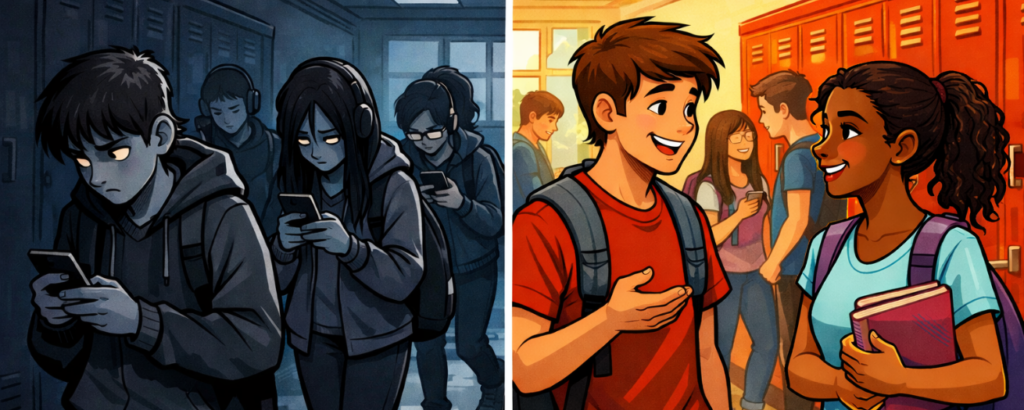
Another positive outcome of the legislation is increased social time in school. If you walk through most public high school’s hallways, you will see a bunch of zombies looking down at their phones, not talking to each other. Similar situations play out at lunch. Students literally co-exist in proximity to each other without actually talking or interacting. It is not healthy nor is it helping student’s mental health.
With so many obviously positive outcomes, it is hard to imagine anyone opposing such legislation, but I have heard from some parents that they worry about not being able to reach their children during the school day.
As an older parent, I find this amusing. When I was in school over 40 years ago, there were no cell phones. If my parents needed to reach me, they called the school. That same system still works today. Additionally, just about every student in every K-12 school has some type of school-issued device with email access. If a parent needed to reach their child immediately, they could send an email; however, there are very few issues that require immediate attention.
To address this concern, the bill requires school districts to provide parents with a method for contacting their child during the school day, and whether an email address or phone number, the school must have staff available to respond.
As a parent with two teenage children — one who attended a public high school where cell phones were allowed and one who attends a private school that does not allow devices — I saw clearly the differences between the two scenarios. Students without cell phone access during school hours are generally more engaged both academically and socially which is why I am hopeful this legislation will become law.
A final added bonus of the bill is that it comes with no cost to taxpayers.
At a time when politics is incredibly polarizing, this is a rare opportunity for elected officials from across the aisle to work together with the goal of improving both academic and mental health outcomes for our children.
Beth Ann Rosica resides in West Chester, has a Ph.D. in Education, and has dedicated her career to advocating on behalf of at-risk children and families. She covers education issues for Broad + Liberty. Contact her at barosica@broadandliberty.com.