

John Rossi: The boys of Fifth Street
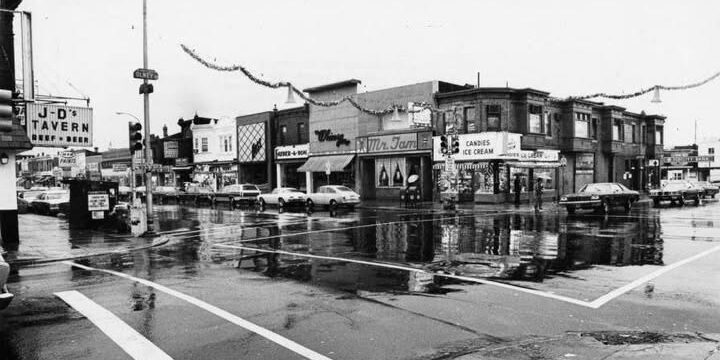
Between 1950 and 1954, from the age of 14 to 17, along with a handful of my friends, my second home was at the corner of Fifth and Rockland Streets at Ted’s Taylor Shop in what I call “Lower Olney.” In bad weather we had a second home: Mr. Bowen’s large black 1941 Buick, parked in front of his saloon on the West side of Fifth Street to which Mr. Bowen’s son, one of our charter members, had a key.
Most evenings, around 7 or so, we would gather at our chosen spot to deliberate our plans for the night. We might go to Hunting Park to watch a ball game, ride the Merry go Round, just hang around or go to the Lindley movie. We didn’t have to pay as one of our friends was an usher and would let us in. On one cold winter night I saw The Snow of Kilimanjaro with Gregory Peck and (more importantly, at least to me) Susan Hayward, four times just to keep out of the cold.
Most nights we talked, then called “shooting the breeze.” We talked about school and girls, movies and girls, TV and girls, sports and girls, always girls. As one of our crowds said: we were broke, bored and horny. For some reason the young ladies of Lower Olney didn’t find us an enthralling group.
It wasn’t a particularly exciting life, but it suited us. We had friends who would stop by with the latest neighborhood gossip, occasionally go to the local bakery and buy a bag of broken cookies, and in summer work up a game of handball or stickball. As Rocky Balboa once said about hanging out: it fills gaps.
Our quiet world changed one day in 1953. A sign went up in Sloan’s Hardware Store window, which had been vacant for a year, that a restaurant would be opening soon. There were no true restaurants in this area of Lower Olney save for The Roosevelt Diner at Fifth & the Boulevard in the south and the Fern Rock Dinner on North Fifth street. We sometimes went to the Roosevelt Diner but it wasn’t our turf and it was not a particularly appetizing establishment with a dirty counter and a propensity for kitchen fires breaking out. An interesting aspect of the Roosevelt was that it had two dining rooms; a counter that ran along the Fifth Street side and a sit-down room along the Boulevard side. To get from one to the other you passed through the kitchen. One such trip and you never ate there again.
The Fern Rock was too far from us, plus it was in enemy territory and had a perpetually angry counterman. He would threaten to kill you if you played the counter jukebox with the latest pre-rock and roll era hits like “How Much is that Doggie in the Window.” Looking back, I can’t blame him.
A restaurant in our own neighborhood was going to be a treat and another possible hangout. The restaurant called “The Lintonia,” opened in late 1953. It was a typical 50s diner with an equally 50s color scheme of green and yellow. There was a counter for quick snacks, a row of booths along the south wall plus a half dozen tables toward the back. Everything gleamed and shined
We waited awhile before gracing it with our business. There were crowds at first and The Lintonia seemed to be thriving. Gus the owner greeted us as he did all customers, at least at first. He was tall and thin, about 50 with a full head of black and gray hair topped with a modified chef’s hat and he seemed pleasant enough. There were two waitresses, an older unsmiling woman named Irma who waited the booths and tables and a young girl named Dot who handled the counter. Irma took an instant dislike to us which we soon reciprocated by avoiding her stations. Dot, on the other hand, was something else.
She was around our age 17 or 18, about 5’7” a brunette with a nice figure that suited her uniforms which were bright yellow or a light green, perfect diner colors. Two things we noticed right away. She wore a black bra and black panties under the uniform which showed through enough to entice our interests. The second thing which stood out and ruined the otherwise pleasant sight was that she was missing a front tooth.
Dot seemed like a nice young girl and I tried “chatting her up” as the English say but two things held me back. One she came from a tough neighborhood in North Philly and regarded us a bunch of snobs and second, no matter how I tried, I could never get over that missing tooth.
The Lintonia did well for a time but it was soon doomed. By the mid-50s, car ownership came to lower Olney. My street, which had four cars in 1950 among 30 houses, now had fifteen including one house with two cars. People could drive out of the neighborhood to shop and eat out. More importantly, Gus was a bad manager. He liked to chit-chat with the customers, including us, and he let the place deteriorate. The floor was always slightly dirty and the men’s bathroom was a smelly bog. The food was pretty bad and we soon learned to limit our intake to coffee or tea.
One of our crowd ate there from time to time as his mother worked nights. I met him there one night as he was having a dinner of meatloaf, mashed potatoes and something called wax beans, the meat and potatoes covered in a yellowish-brown gravy. That ended any chance of me ordering a meal there.
What finished The Lintonia was a dispute between Gus and a young guy named Peppi.
Peppi was a hero to us. He was around 20, owned a yellow Indian motorcycle and dressed and looked like Marlon Brando. We thought he was tough and cool. Apparently, Peppi was eating on the tab at the Lintonia and couldn’t pay his bill. One night Gus snuck out and took Peppi’s cycle and locked it in the storeroom. When Peppi found out there was a loud argument and blows exchanged. Someone called the cops who resolved the situation in a manner that would have made the United Nations proud. Gus kept the cycle until Peppi paid half his bill. They would check thereafter to see the rest of his tab was paid.
The news of the fight doomed The Lintonia. Along with the bad press it had gotten business slowly dried up. We found new headquarters and avoided the place. Gus once stopped me on the street and asked why we weren’t coming around anymore. I made some excuse. The Lintonia closed in late 1955. A couple of years later one of my friends said he thought he saw a sad looking Gus walking along Race Street in what was then called “The Tenderloin.”
John P. Rossi is a former Professor of History at La Salle University.
For a lot of us in North Philly it was the Hot Shoppes at Huntington Park Avenue