

Partisan split emerges as Chester County reviews 1,000+ provisional ballots
Following the error on election day when over 75,000 registered voters were left off the pollbooks, the Chester County Board of Elections held a five-and-half-hour hearing before a packed audience on Monday over challenges to provisional ballots. The Republican Committee of Chester County challenged over 1,000 ballots related to envelopes and signatures, and the Democratic-majority board voted to count all but three of the provisional ballots.
All three members of the Board of Elections — who also serve as the county commissioners — acknowledged the county’s mistake and ensuing confusion and frustration; however, their remedies, as well as those of the Republican and Democratic committees, diverged along partisan lines.
Democrats said that it was unfair to disenfranchise voters as a result of the county’s mistake, while Republicans said the county must follow the law.
Eric Roe, the minority Republican board member focused on “legal originalism” in his comments prior to the vote.
“We are required to rely on what the law says, not what we wish it said,” said Roe. “I wish the law explicitly stated that an extraordinary circumstance like a man-made pollbook error or omission afforded me the right to provide an equitable remedy for disenfranchised voters. It does not. Instead it says that ballots without secrecy envelopes shall not be counted.”
The proper process for casting a provisional ballot requires the voter to complete an outside envelope with identifying information — name, address, phone number, and email address. The voter signs beneath that information and then completes the provisional ballot which is then placed in a secrecy envelope and sealed. The sealed secrecy envelope is then placed in the outer envelope which is subsequently sealed, and finally the voter signs Section C in front of the Judge of Elections. The voter is supposed to wait for the Judge of Elections to complete and sign the outer envelope at which time they are given a provisional ballot receipt with a tracking number.
The instructions for voting with a provisional ballot clearly state that votes will not be counted if the ballot is not inside the secrecy envelope or if the voter’s signature is not in both locations.
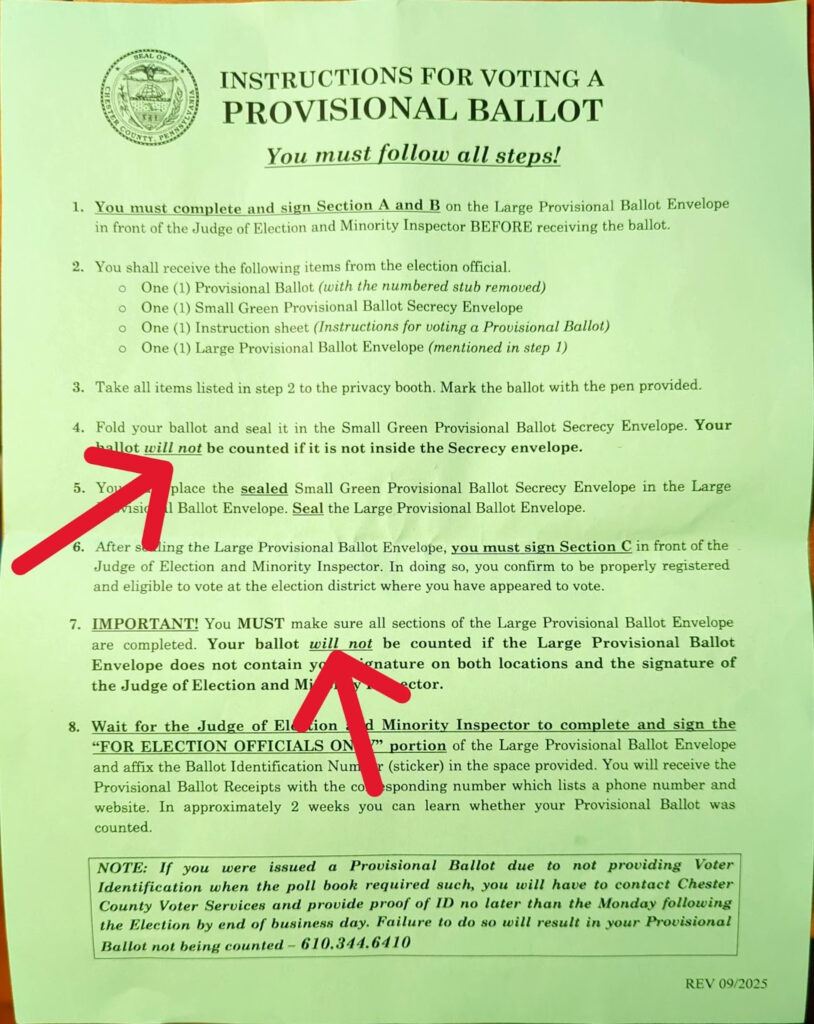
The Board of Elections voted on four different categories of problematic provisional ballots, most of which were related to the envelopes. Some ballots were not placed in a secrecy envelope, some had a secrecy envelope but the ballot was not sealed inside it, and others had a different envelope entirely. Ultimately, Democratic board members Josh Maxwell and Marian Moscowitz voted to count those ballots.
The remaining three ballots in question were not counted because they were only in a secrecy envelope without a name or signature so there was no way to confirm who had cast the ballot. All three board members voted to exclude those.
Charlotte Valyo, chair of the Chester County Democratic Committee (CCDC) was satisfied with the outcome of the hearing.
“CCDC thanks everyone who voted on November 4th, especially the 1200+ voters who voted provisionally due to an error in the voter books,” said Valyo in a statement to Broad + Liberty. “CCDC believes there must be a full and transparent investigation. That process has been initiated. CCDC fought to ensure every legally cast provisional ballot was counted regardless of voter registration and is pleased the Board of Elections voted to count almost all the challenged ballots.”
Raffi Terzian, chair of the Republican Committee of Chester County (RCCC) was displeased with the outcome — and more specifically with the circumstances that created the issue — and had previously sent a letter to the Board of Elections insisting the election should not be certified under any circumstance.
“It is clear that the gross incompetence of Democratic leadership in our county directly led to the November 4th debacle that disenfranchised voters,” said Terzian. “Republicans first sounded the alarm when voters were missing from the pollbooks. Poll workers received inconsistent and delayed guidance from voter services which compounded the chaos. Republicans have rightly raised questions about the provisional ballots and those voters who were turned away as it is essential to protect a lawful and transparent process for every voter. We remain firmly committed to election integrity and to upholding the law.”
The hearing was not intended to address the issue as to how the problem occurred. However, during the hearing, the county announced on its website that a local law firm was selected to conduct an “independent investigation.”
According to the press release, “ten firms were invited to submit proposals in response to an independent investigation scope of work, prepared by Chester County’s senior administrative team. Fleck Eckert Klein McGarry, LLC was selected based on its experience in complex investigations, its knowledge of election-related legal issues, and its independence from Chester County Government.”
The investigation is expected to focus on five key questions, including the root cause of the incomplete pollbooks; the processes and procedures in place to ensure accuracy; how those processes failed; any other factors that contributed to the failure of voter services staff from identifying or reporting concerns; and what caused the significant delays in mitigating the issue.
This is not the only investigation underway to answer the questions as to how this critical mistake was made.
Wally Zimolong, an experienced attorney in election law and ballot access, announced last week that his firm was launching its own investigation into “widespread voting irregularities reported in Chester County.” His investigation, however, is aimed towards the Board of Election’s failure to properly conduct the election.
“Every eligible and legal voter has a constitutional right to vote,” said Zimolong in a statement. “To ensure that right, the Chester County Board of Elections must adopt adequate policies and procedures on how to administer an election and must properly train its staff on how an election must be conducted. If the Board failed to do either and it caused voters to be disenfranchised, the Board should be held liable. Our investigation is focused on determining whether the Board fulfilled its obligations to properly train its personnel and adopt adequate election administration policies and procedures. If not, then we intend to hold the Board accountable so that this never happens again.”
Beth Ann Rosica resides in West Chester, has a Ph.D. in Education, and has dedicated her career to advocating on behalf of at-risk children and families. She covers education issues for Broad + Liberty. Contact her at barosica@broadandliberty.com.

This story only addresses the challenged provisional ballots. If 75,000 registered voters were left out of the pollbooks, how many provisional ballots were received as a result?