
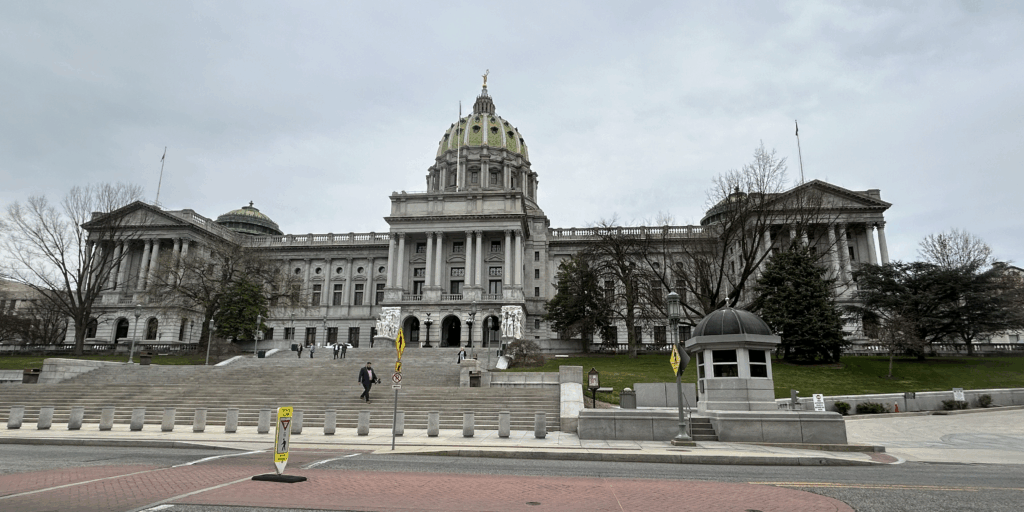
Guy Ciarrocchi: Pennsylvania’s budget bullies cyber students out of their money
The Pennsylvania state budget for 2025-26 is finally law — just 135 days late. The budget grew 5.1 percent, and will spend an eye-popping $3.5 billion (with a “B”) more than the Commonwealth will receive in tax revenue.
Yet despite this taxpayer-funded deficit-spending spree, one area of the $50.4 billion budget was cut: funding for cyber charters students.
For the second year in a row, over 68,000 K-12 students from Erie to South Philly will get less funding — retroactive to the start of this school year, beginning three months ago. Tragically, too few Harrisburg politicians care about those children, and almost no politician fears the wrath of their parents, families, and the schools’ staff. Plus, far too many love the teachers union — or fear their wrath.
Cyber students are the weaklings in the political schoolyard. It’s why their funding — already only about 65 percent of what a traditional district public school student receives — was slashed about eighteen percent. One year after it was cut seven percent. (Reminder: the money not sent to the cyber schools stays with the students’ homes school district — the very ones they fled. The ones getting paid not to educate the child.)
It’s a tragedy.
Sadly, the last few weeks have played out like the famous scene in The Godfather — the brilliant juxtaposition of the baptism (joy) with the murders (revenge) playing out simultaneously.
Aside from my personal passion for school choice, because of my work in government and years serving as the Chester County Chamber CEO and member of the US Chamber’s Committee of 100, I’ve had the chance to work with countless Chambers, business, manufacturing, agriculture and life science organizations and businesses. Now, one of the things that I work on is helping cyber high school students find internships, shadowing experiences and mentors — and I work to connect cyber schools with chambers, businesses and community colleges to foster long term career-focused relationships for students.
That’s what made the juxtaposition of what was happening over the last few weeks all the more cruel. At the same time cyber schools were having conversations with their business and college partners, what was happening at the same in Harrisburg back rooms and in the House and Senate chambers was focused on cutting their funding and regulating them to death.
A discussion among cyber schools counselors, internship directors and school officials with officials from a regional hospital to create internships and shadowing experiences for juniors and seniors…yet, at the same time, in Harrisburg, the education establishment — and groups funded by the teachers’ unions — hold press conferences decrying “too much” money in cyber schools (again, where students had been getting only 65 percent of what a district public school student gets).
A discussion among cyber schools counselors, internship directors and officials with officials from a regional community college to discuss the possibility of creating a dual-enrollment programs — so that the cyber’s high school students could graduate with college credits, possibly even an associates degree…yet at the same time, under pressure from the teachers’ union and public education establishment, legislative budget negotiators were crafting a budget that slashed funding to cyber students by $178 million. Predictably, at the same time, increasing funding to traditional public schools by almost $1 billion.
That’s $178 million less for the schools growing in popularity, yet nearly $1 billion more in taxpayer funding for the schools that students are leaving — often due to violence or failing academics.
Why? To prop up the teachers union schools and harm their competitor schools.
A cruelly ironic juxtaposition of “scenes:” Democratic politicians during the budget debate in Harrisburg (and, the federal budget) yelling about the needs of poor children, pontificating about the needs of LGBT students in sports and locker rooms, yet cutting funding to cyber schools — schools that educate a student population poorer than the average public school students (e.g., cyber schools have twice the rate of students without homes), and cyber schools have a significant number of students who identity as part of the LGBT community, often fleeing their public school due to bullying or feeling left out.
How ironic, how insincere, how cruel that the very Democratic politicians seeking their own moral high ground — pretending to defend the poor and various minorities — are the very ones leading the angry charge to cut the schools that are the refuge for so many of those students.
The final contrast: a governor running for president touts streamlining the regulatory system for businesses needing Harrisburg approval to get work done…yet, his new budget saddles cyber charter schools with new forms and regulations, and having to submit more paperwork for approval to the very school districts that see them as competition — standing in judgement of whether the cybers get paid to educate kids who fled their schools.
Cyber schools: public schools chosen by parents/guardians to educate over 68,000 Pennsylvania children just had $178 million slashed from their schools, and were saddled with more unnecessary, bureaucratic paper-work.
It’s a timeless school tragedy: the bullies picking on the weakling in the capitol’s school yard.
Guy Ciarrocchi is a Senior Fellow with the Commonwealth Foundation. He writes for Broad + Liberty and RealClear Pennsylvania. Follow Guy at @PaSuburbsGuy.

It is a shame what they did to the Cyber schools. You’re correct to call it bullying.
Pennsylvania’s constitution requires its Governor to submit a balanced budget proposal, with expenditures not exceeding estimated revenues and available surpluses. This 2025-26 budget did that using one-time sources: drawing down the General Fund balance by $3.9 billion (from prior-year surpluses), redirecting $1.5 billion in lapsed (unspent) funds from previous appropriations, and transferring $670 million from off-budget “shadow” accounts. This specific budget has spending outpacing recurring revenue by $5.1 billion. In the very near future, if spending is not cut by 10% or so, our taxes and borrowing will increase significantly.
PA was financially sound before Shapiro. And it is less so, now. Gov Shapiro is doing the same thing as Gov. as what he did when he was a Commissioner in Montgomery County. The local hosts of 1210 AM voted for him. Call them, and ask why they voted for a guy who had a history of being fiscally undisciplined, and why they think pushing for illegal drugs to become legalized, simply to get more money, would be good long term for PA or our children.
I assume cyber schools have far less in costs associated with brick-and-mortar school. They do not need much in the way of a physical plant. They should have far less in costs for utilities, insurance, maintenance. Since brick-and-mortar schools must be able to switch to at-home instruction, they also need to maintain cyber capabilities.
The costs to the original district don’t completely decrease as students sign up for charters. The fixed costs can’t simply evaporate.
Is there some reason why the cyber schools should be reimbursed for costs they are not incurring?
I also assume that the cyber school attendees were not ALL bullied though it is reprehensible if any of them felt forced into a cyber school.
I look forward to your reply.
I am wondering at what point do we focus on what is best for the STUDENTS?! Not the teachers, not the administrators, not the brick and mortar buildings or sports facilities, but the STUDENTS!!
Do not disagree but nothing in the article addressed that either. I am asking about why we need to pay X amount regardless of the actual cost of the program. Fair does not always mean equal.