
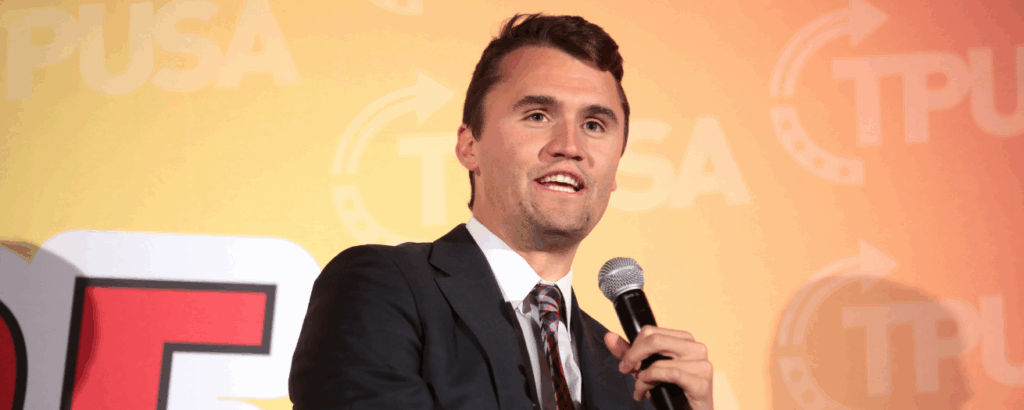
 Gage Skidmore
Electrical silence from college leaders on Kirk’s assassination
The assassination of Charlie Kirk while engaging students during an open mic session on a college campus should have stunned the whole nation. While the planned, sniper-style, single-bullet and deadly shot pierced the hearts of many of his followers, there was a disturbing number of haters that made sport of his silencing.
Regardless of the ostensible reason why the assassin killed Mr. Kirk, the action was an attack on
- the American ideology espoused in documents still revered worldwide.
- our freedom of speech.
- our freedom to assemble.
- our freedom to petition our government.
- the principles, beliefs, and practices of those who come from a Judeo-Christian tradition.
For the most part, the reaction from the nation’s college leadership is electrical silence. Such lack of any public sentiment from this sector is peculiar for two reasons. First, the academy historically and presently touts itself as open to the marketplace of ideas. Mr. Kirk, who is described by our disingenuous legacy media as a “right wing political activist,” boldly took to a microphone and went into many hostile environments to speak up for faith, family, freedom, responsibility, and respect for the law and life. For this his life was cut short at the age of 31.
The second odd reason for such muted sentiment that a high profile, socio-cultural, and political maverick had fallen under their assumed guard is that over the past decade university presidents and deans have made wide-ranging statements to their communities regarding socio-cultural and political issues, actors, and events. They strongly espoused who stands for the good, who is deemed bad or ugly, whom to support politically, whom to vote for, who matters, what health treatments to endorse, and what and how we should teach.
The fact that students at our colleges are taught by liberal and overwhelmingly one-party affiliation faculty is not new to the public. Several books have been published since the 1960s that explain the change from in loco parentis to several ideologies that at the least thumb their nose at the motto Pro Deo et Patria to radical calls to burn down the mission.
Kirk was acutely aware of this development and gives such critique in detail in his book: The College Scam: How America’s Universities Are Bankrupting and Brainwashing Away the Future of America’s Youth. Most academic leaders and faculty in universities take umbrage with this work. That’s understandable; however, the public’s respect for and their opinion of the utility of universities and the professorate had been declining.
In fairness to college presidents, it is understandable that they have lost their whistle and find no energy to call out an unequivocally politically motivated assassination by a college-age male.
It is not that they feel confident that they will get support from a significant number of their colleagues that it is okay to temper or silence the opposition. The electrical silence stems from what Kirk aimed for: a Turning Point. Recently a significant number of parents, donors, alum, legislators, public officials, and commentators have called out those “managing the mission,” from the student services staff to the Board of Directors and the throngs of people in between.
In the marketplace sphere colleges today have low enrollment challenges which naturally drive most schools’ financial stability. On top of this they have a self-inflicted accountability problem and cries of mission creep by public and private funders with the latter considering that they may not deserve the special status of being a tax exempt nonprofit entity.
Even if viewed as private corporate actors, the academy’s value has diminished in its “core services” of teaching, research, and service. The metamorphosis of the college experience ranges from the endearing outcome of finding oneself, to a nostalgic enlightenment, to becoming useful and productive employees.
Regarding teaching, the mantra that “the goal of college is to learn how to think” — often operationalized by specifying what to think about, discuss, and debate — looks more like professors directing students on what to think. Concerns about indoctrination are no longer dismissed as conspiracy theories.
Critics claim that some research enterprises have shifted from being disinterested generators of new knowledge to being driven by ideological agendas. A commitment to the epistemic challenges of research is waning. Many question whether investigators are still interested in veritas, or in some cases, falsely reporting an alternate reality to students and the public.
There is evidence that the service time of faculty and students, which historically focused on improving the human condition in terms of health, welfare, and wealth, is being replaced by advocacy efforts aimed at calling out and silencing oppressors. More time is spent on dismantling than on building. Students should see role models who are builders; it is easy to strike a match and burn a building, but it is far more challenging to construct one.
Ostensibly, the academy is filled with dedicated individuals who would fall on their swords to protect academic freedom. However, the most disenfranchised students and faculty on American college campuses today are those with conservative views, certain political party affiliation, and those who identify with Judeo-Christian religions.
Being a college president today is no easy job and will continue to become more challenging. One can understand that their jobs may be at risk when they speak out. However, there is nothing difficult about taking a public stand when a peaceful, decent man is gunned down on one of their campuses. What we all witnessed in the assassination of Charlie Kirk is not a matter of nuance.
Stephen F. Gambescia, a university professor, teaches courses in healthcare policy and managing nonprofit organizations.

Respectfully there are some matters of nuance regarding this assassination and murder of Kirk. Supposedly historical (WW2 and beyond) and experimental evidence substantiates that .30-06 shots to the neck fail to exit in about 1 in 3 to 1 in 4 cases. So, the lack of an exit wound and lack of released autopsy report (an autopsy is required by Utah law for homicides so let’s assume one was done) do not disprove the official Charlie Kirk narrative; however, a nuanced evaluation is absolutely necessary to accept the official narrative of the “Who”, “How”, “What” and “When.” Too many very odd data points: where videos start and stop (why no video showing the shooter set-up, shoot, or disassemble the weapon but they are willing to show a snipped version of someone running across the roof without an obvious weapon), other actors (bodyguards fleeing after taking discrete handoffs seconds after the shot, immediate claims of responsibility by George Zinn) and someone that turned themselves in 30+ hrs. later yet won’t cooperate. But you are absolutely correct the “Why” was an attack to stop all the points you outlined in your article which Kirk so effectively communicated.
What is beyond odd and deserves a serious deep dive by the press… FBI Director Kash Patel will literally tweet supposed evidence potentially jeopardizing an active investigation but will tell us his hands are tied when it comes to releasing any Epstein files.