
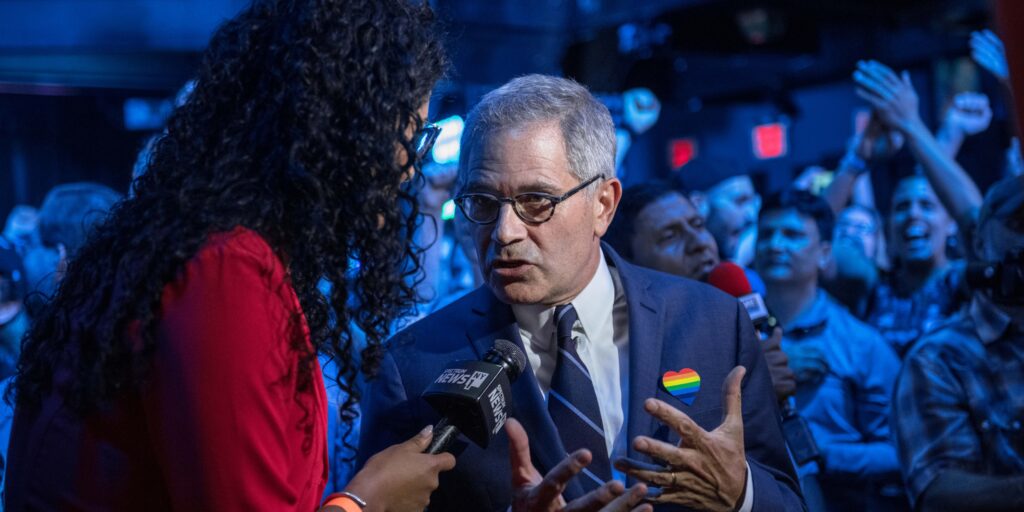
Emails show questionable collusion between Krasner and PAC donors
Philadelphia District Attorney Larry Krasner, long a focal point in the national debate over progressive criminal justice reform, faces escalating legal and ethical scrutiny after a trove of documents revealed extensive coordination between his campaigns, outside political action committees, and a powerful nonprofit consulting operation.
The findings, resulting from open records requests obtained by the Law Enforcement Legal Defense Fund (LELDF), uncover a network of relationships that not only push the boundaries of ethical conduct but, under federal and local law, may cross into unlawful territory for candidates and political action committees (PACs).
At the heart of the issue is the strict legal prohibition against politicians and candidates coordinating directly with PACs. Federal statutes alongside Pennsylvania’s election laws explicitly forbid collaboration on campaign strategy, expenditures, or messaging between candidates and these independent political committees. Violations of these firewalls fundamentally undermine limits on campaign contributions and can distort the integrity of democratic elections.
As policy director Sean Kennedy of the LELDF, who spearheaded the public information request, notes: “Conflicts of interest are the Wren Collective’s business model — supposedly working for prosecutors’ offices while being paid by outside groups backing the same DA’s campaigns. In Larry Krasner’s case, Wren didn’t serve two masters — it served three, simultaneously working on behalf of Krasner’s campaign, Real Justice PAC, and the district attorney’s office itself.”

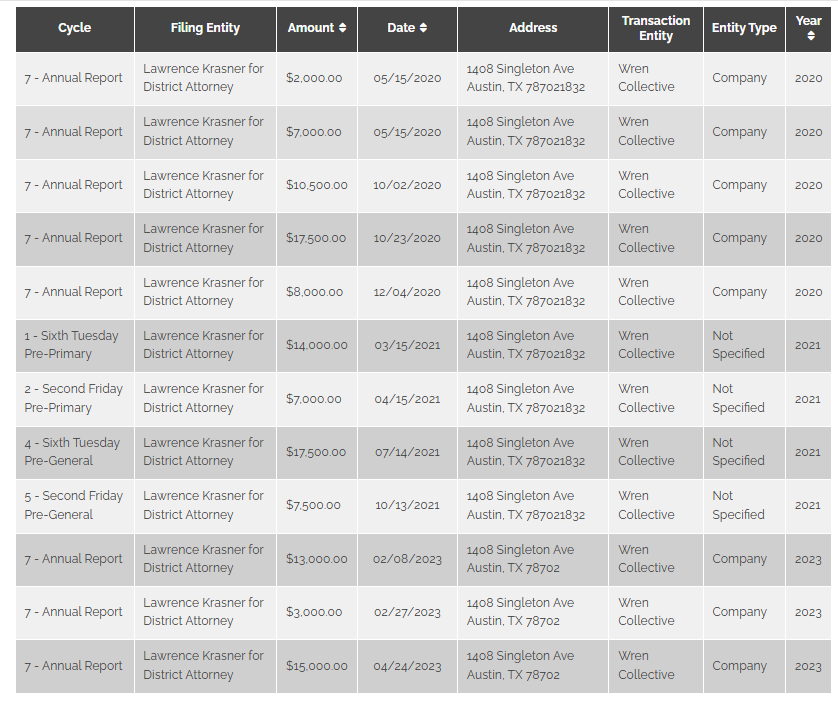
The Wren Collective, a consulting firm embedded in progressive prosecutor offices across America, features prominently in the documents. Founded by Jessica Brand, Wren has not only advised on policy, but shaped public messaging and, in Philadelphia’s case, worked in coordination with both Real Justice PAC (an influential national political committee) and Krasner’s official office, which may be in violation of Pennsylvania campaign law.
Wren was paid both as a campaign vendor and a consultant to the District Attorney, financially entwined on multiple fronts. Settlement agreements from the Philadelphia Board of Ethics in 2019 and 2021 confirm that Real Justice PAC exceeded legal contribution limits when it provided staff, funds, and direct campaign support to Krasner, with Wren simultaneously acting as a vendor for both the PAC and the committee. Furthermore, later Broad + Liberty reports showed that Real Justice PAC previously rented office space from Tiger Building LP, in which Krasner is a co-owner, raising questions as to whether Krasner can personally profit from PACs.
Speaking to this convergent influence, former Chester County DA and federal prosecutor Thomas Hogan warns: “Overall, Wren and entities like Fair and Just Prosecution act as the coordinating brain of the progressive prosecutor movement. Because of the way they are financially structured, they allow some of the high-profile liberal donors to funnel money to progressive prosecutors while leaving a very murky trail.”
Shared Funding: Soros, Tides, and Networks Fueling Unrest
Investigation into the Wren Collective’s funding reveals an interlocking web of left-leaning donors and dark money activist groups. Wren operates under the fiscal sponsorship of Social and Environmental Entrepreneurs (SEE), a passthrough nonprofit that receives and disburses millions from the Soros Open Society Foundation, the Tides Network, the Schusterman Foundation, and the Arnold Foundation among others.
As Kennedy stresses, “Wren is largely funded by hard left billionaires’ foundations and PACs but is not above taking taxpayer money when offered, as it did in Los Angeles and Minneapolis. Because Wren uses a passthrough nonprofit as its ‘sponsor’ most of its direct funding is hidden from view. Its parent organization has taken tens of millions of dollars from Soros-linked groups”.
Notably, many of these same donor networks — including the Tides Foundation, Soros’s Open Society, and others — have been identified by independent watchdogs as financing not just prosecutorial campaigns but activist collectives such as the Ruckus Society. These groups have been at the forefront of civil unrest, organizing unlawful protests on college campuses following the murder of George Floyd in 2020 and leading or funding anti-Israel demonstrations after the October 7 Hamas attack, sometimes resulting in racial intimidation, property destruction and violence.
“Many of Wren’s indirect donors also bankroll extremist groups and advocate for radical policies. And the company Wren keeps speaks volumes as one of its most prominent collaborators is Marxist Radical Angela Davis,” Kennedy adds, underscoring the far-reaching impact of these networks on both policy and protest.

Neither the Wren Collective, nor Real Justice PAC, nor Krasner’s office returned Broad + Liberty’s requests for comment.
The documents capture direct communications — many using private Gmail accounts — between Krasner, Wren staff, Real Justice PAC’s Brandon Evans (who served as Krasner’s campaign Manager) and Shaun King (who settled a defamation suit from Carlos Vega from Krasner’s last campaign), the Grassroots Law PAC, as well as other progressive prosecutors across the country. The other prosecutors on Krasner’s emails included ousted California DAs Chesa Boudin of San Francisco and George Gascon of Los Angeles, as well as Marilyn Mosby of Baltimore (convicted of mortgage fraud and perjury in 2024), indicted Mississippi DA Jody Owens, and a sizable contingent of active defense attorneys who may have policy conflicts with these sitting county prosecutors. These emails not only blur the distinction between campaign and government work, but constitute explicit violations of the law barring direct coordination between candidates and PACs.
Ethics Board settlements detail how Real Justice PAC embedded staff within Krasner’s campaign, managed grassroots drives, bought ads, and shared vendors with the Wren Collective. All told, Real Justice’s and Wren’s interconnected roles provided both campaign muscle and policy direction from the same shadowy playbook — while being simultaneously paid by, and supporting, the candidate they were supposed to remain independent from.
Implications for Policy and Prosecution
J. Shane Creamer, Executive Director of the Philadelphia Board of Ethics, which enforces campaign finance law locally, explained, “As a general matter, we are prohibited from discussing potential violations of the laws that we administer and enforce.” When asked about the emails that show the Wren Collective is coordinating with both Krasner and Real Justice PAC, Creamer said “Wren appears to have been a vendor for the Krasner Committee…and as I’m sure you know, the Board has settlement agreements with Real Justice and the Krasner Committee in 2019 and 2021.”
The implications of these findings reverberate well beyond Philadelphia. Documents show Wren and peer organizations actively shaping both campaign strategy and the policies implemented by the very prosecutors they help elect. The same funding streams, in some cases, back protest groups and advocacy organizations whose members could face prosecution — further muddying questions of independence and public accountability for chief law enforcement officials.
“Contributions (including coordinated contributions) to city candidates are subject to the city’s contribution limits, however, independent expenditures are not subject to those limits. The rules for whether an expenditure to influence an election is coordinated with a candidate committee are in Subpart I of Board Regulation #1”.
But as Kennedy observes, the inherent conflicts are not a bug but a feature of the progressive prosecutor movement’s approach: “Conflicts of interest are The Wren Collective’s business model — supposedly working for prosecutors’ offices while being paid by outside groups backing the same DA’s campaigns”.
With fresh revelations now public, attention turns to the difficult question of enforcement.
Even with repeated Ethics Board citations, settlements and the paltry fines levied against Krasner and the penalties against Real Justice PAC for excessive and coordinated contributions, current oversight may be inadequate in containing the rapidly evolving and increasingly opaque nexus of money, policy, and political power. Furthermore, a question looms as to whether the coordination described in these emails raises to the level of a conspiracy to violate campaign finance laws, which is something that should be answered by Attorney General Dave Sunday, the US Department of Justice, or the Pennsylvania House of Representatives, which previously impeached Krasner.
As Philadelphia voters approach another pivotal election, the debate centers not simply on the merits of particular reforms, but on the basic requirements of independence, transparency, and legality in public life. The Krasner-Wren saga has become a case study in how closely intertwined donor-driven activism and the machinery of American criminal justice have become — and a clear warning that the law intends for far more separation between those with the power to prosecute crime and those with the money to shape their conduct.
Based in Philadelphia, A. Benjamin Mannes is a consultant and subject matter expert in security and criminal justice reform based on his own experiences on both sides of the criminal justice system. He is a corporate compliance executive who has served as a federal and municipal law enforcement officer, and as the former Director, Office of Investigations with the American Board of Internal Medicine. @PublicSafetySME

Amazing reporting of fresh revelations!
The prior 2021 “settlement”, which Executive Director of the Philadelphia Board of Ethics referenced, specifically dealt with a very limited issue of $48k of excess pre-candidacy contributions… this matter (a grand alleged conspiracy some may describe it) seems an entirely different issue altogether.
What is the motive of these groups: Proud Marxist Angela Davis, the Tides Foundation, Soros’s Open Society, etc? Are they doing this for money? A follow up report on their motives could be enlightening.
RICO indictments to follow…