
 Photo by Joe Gratz via Flickr
Commonwealth Court narrows scope of party governance
On September 16, 2025, the Pennsylvania Commonwealth Court issued a major opinion in the case of In re Bucks County Republican Committee (769 CD 2024).
The case may not draw much attention outside of political circles, but its impact reaches deep into the way parties are run across the state. It makes clear that political parties are not above Pennsylvania law.
This is not the first time a Bucks County dispute has set precedent. Only two years earlier, in 2023, the Pennsylvania Supreme Court decided Mohn v. Bucks County Republican Committee. That case, written by Justice Thomas Saylor before his retirement, was widely interpreted as granting parties broad leeway to discipline their own members without court interference. Together, the two cases tell the story of where courts draw the line between internal politics and the rule of law.
The Mohn case arose when Daniel Mohn, a duly elected committeeperson in Bucks County, was removed from his position by the county party’s executive committee. His alleged offenses included campaigning against an endorsed candidate and publicly questioning the value of the party’s sample ballot. Mohn challenged his removal in court, arguing that the party’s ethics rules did not apply to him and that his due process rights were violated.
The courts rejected his claims. The trial court and the Commonwealth Court sided with the party, and the Pennsylvania Supreme Court affirmed. Justice Saylor’s opinion stressed that courts should be reluctant to interfere in purely internal party disputes, particularly when the matter involves ideology or political loyalty. As long as party rules exist and provide a basis for discipline, the judiciary generally defers.
Mohn gave party leadership across the state a shield. It was read as saying, in effect, that if you were disciplined under party bylaws, the courts would not step in. That interpretation became a constant refrain in local disputes, often cited to justify top-down control and to warn committee members that challenges were futile.
The New Bucks County Ruling
This week’s decision, however, narrows the scope of that shield. The dispute centered on the Bucks County Republican Committee’s June 2022 leadership election, which was conducted using proxy votes and roll call procedures. Committeepersons challenged the election, arguing those methods were not authorized under valid bylaws and violated Pennsylvania’s nonprofit laws.
The Commonwealth Court agreed in part and reversed the lower court’s dismissal for lack of jurisdiction. The justices emphasized that Pennsylvania’s Nonprofit Corporation Law and Nonprofit Association Law explicitly cover political organizations. That means county and state party committees are bound by the same governance rules as every other nonprofit in the state.
The heart of the court’s ruling is as follows:

The opinion went further. It noted that bylaws must be properly adopted, signed, and filed to be valid. Draft versions, unsigned word-processed copies, or bylaws filed after the fact do not suffice. If proxy voting or roll call procedures are not spelled out in valid bylaws, they cannot be used:
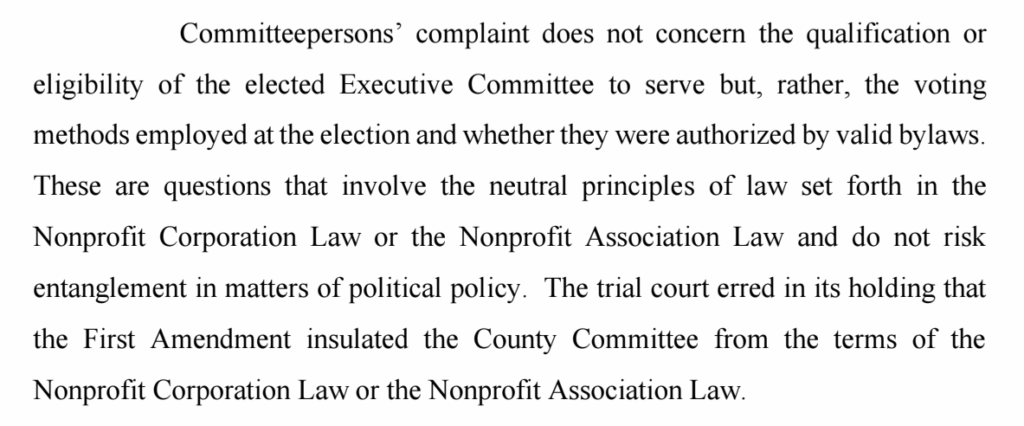
The court stressed that this was not an ideological dispute but a matter of “neutral principles of law,” and the First Amendment’s freedom of association does not excuse parties from complying with neutral statutory requirements.
How Mohn Was Used Across the State
The 2023 Mohn decision was not confined to Bucks County. It quickly became a rallying point for party insiders statewide. County committees from Philadelphia to Allegheny pointed to it as justification for rewriting bylaws that concentrated power in smaller executive boards, limited the rights of elected committeepersons, and shut down grassroots participation. When challenged, leaders frequently invoked Mohn as proof that “the courts won’t interfere.”
These changes were often framed as “modernization” or “efficiency,” but the effect was to silence dissent and insulate leadership from accountability. The precedent set in Mohn was stretched far beyond its original facts, used as cover for structural power grabs.
At the same time, America First grassroots activists inside the Republican Party began pushing back. Across Pennsylvania, committee members organized to defeat bylaw proposals that stripped away their rights. In county after county, rank-and-file members rejected leadership’s arguments that they were powerless. They understood that Mohn was being misused as a cudgel rather than a shield.
The Commonwealth Court ruling vindicates that resistance. By clarifying that nonprofit statutes apply, it gives grassroots members a firm legal foundation. It reasserts that rules must be lawful, bylaws must be valid, and leadership cannot operate outside the framework that binds every other nonprofit in the state.
The Shift in Legal Ground
The contrast between Mohn and the 2025 ruling is striking. Mohn taught that courts would not referee ideological disputes inside political parties, even when a committeeperson was removed for bucking the endorsed line. The new Bucks County decision clarifies that when procedural and statutory compliance is at stake, courts do have jurisdiction.
This means that while parties retain wide discretion to discipline members for political reasons, they cannot disregard the basic legal framework that governs nonprofits. They must have valid, enforceable bylaws, and they must follow them. If they conduct elections or enforce rules outside that framework, those actions are open to judicial review.
Attorney Joshua Prince, who argued the case along with Andrew Teitelman, underscored the importance of this ruling in his public statement. He noted that the Republican Party of Pennsylvania argued it was completely exempt from state law. The Commonwealth Court rejected that position outright. The message was clear: political parties cannot campaign on law and order while exempting themselves from the statutes that apply to every other nonprofit.
This is a bipartisan issue. Both Democrats and Republicans operate through nonprofit county committees and state committees. Both rely on volunteers, bylaws, and internal elections to sustain their organizations. The Commonwealth Court’s decision ensures that the same baseline of accountability and transparency applies across the board, regardless of ideology.
The trial court will now decide the specific fate of the Bucks County leadership election, but the precedent is already set. Courts will respect internal political debates, but they will enforce neutral governance rules. The line is clearer than it has been in years. Parties can discipline members for politics, but they cannot ignore the law.
Ada Nestor is the co-host of the The Conservative Voice radio show in Philadelphia and writes Reflections from the Edge on substack. You can reach her on X at @AdaNestorWC.
This is actually very important topic. Thank you.
BTW, Haverford Township Republican website as of 9/17/25: Home page has a clock set to 00:00:00:00 for the MAY 2025 PRIMARY ELECTION!!!!!! They have zero mention of ANY current Republican candidates. Leadership is so bad that it seems reasonable to question if GOP has been co-opted by the Dems. How do we replace and/ or fire the following people: 1) Jim Knapp, Chairman 2) Kay Dugery, Vice Chair 3) Jim Hazelton, Second Vice Chair 4) Myssi Haub, Recording Secretary 5) Mike McMahon, Corresponding Secretary and 6) Bill Gowie, Treasurer – in all seriousness? Do these people get paid?
Conversely, the Haverford Township Democrat website as of 9/17/25 on their Home Page informs all: Last day to register to vote: Oct. 20, 2025. Last day to request a mail-in or absentee ballot: Oct. 28, 2025. They list every current candidate, and they list contact info for a different person for each Ward and each Precinct. The Dems are crushing the Republicans because they are better organized.
Great, America First pushes back on party leadership. Maybe they’ll foist another Mastriano nomination on us. That worked out so well, last time.