 The White House
Can the National Guard stop crime beyond D.C.?
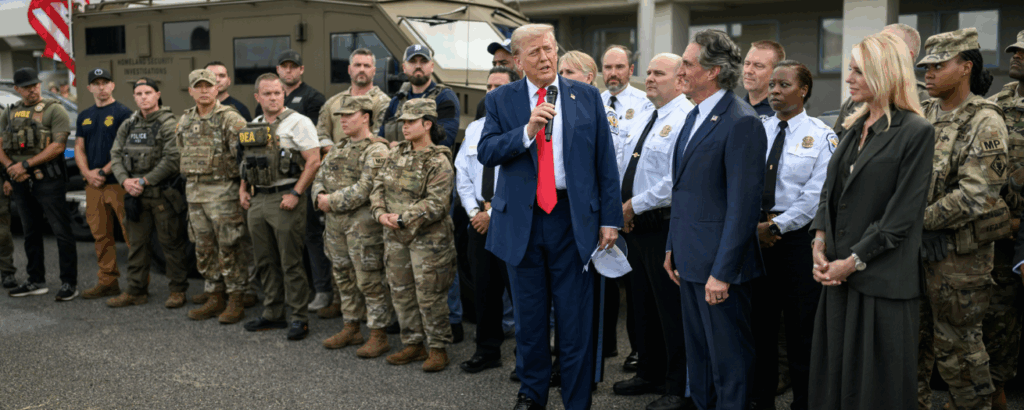
While President Trump’s recent deployment of the National Guard to assist federal law enforcement in Washington, D.C., has been successful in curbing out of control crime in our nation’s capital, Washington’s unique legal landscape makes it hard to duplicate in other crime-ridden cities.
D.C. is not a state, and federal law enforcement agencies like the US Park Police, Federal Protective Service, Secret Service Uniform Division, and US Capitol Police already had concurrent jurisdiction to police the streets with the Metropolitan Police and Metro Transit Police. As D.C. never bothered to establish their own local prosecutor or sheriff, the US Attorney’s Office and US Marshals Service, both reporting to Attorney General Pam Bondi, fill those key roles in assuring that the work done by law enforcement on the street is followed through the courts.
As the administration looks at expanding this strategy throughout the nation, it’s important to note the barriers to success the Trump administration may face.
Legal Barriers to National Guard Deployment
Unlike D.C. — where the President serves as an analogous local executive under the Home Rule Act and can unilaterally command the National Guard — cities like Chicago or Philadelphia require cooperation from state and local authorities for the police augmentation necessary to arrest and charge criminals under state law. The Posse Comitatus Act strictly limits the use of federally controlled military forces, including the Guard, for civilian law enforcement unless expressly authorized by federal law. Only under exceptional statutes like the Insurrection Act or Title 10 of the U.S. Code may the President federalize the Guard in cases of a natural disaster, rebellion, or law enforcement collapse, but even these exceptions are limited: a federal judge recently blocked Trump’s California Guard deployment, finding insufficient justification under these laws.
In practice, unless the Guard operates under state authority (Title 32 status), they cannot engage in arrest, search, or direct policing within another state’s borders without explicit cooperation from local governments. Thus, for National Guard troops to conduct arrests or conventional patrol work in Chicago, they would need to be formally deputized by local law enforcement and their actions prosecuted by offices such as the Cook County State’s Attorney or a district attorney like Larry Krasner in Philadelphia — who are politically disinclined to cooperate.
The National Guard’s Limited Law Enforcement Role
In my personal experience as a former D.C. Metropolitan Police officer assigned during past National Guard deployments, including interventions at open-air drug markets two decades ago, the Guard provided visible deterrence and light trucks, but lacked the powers or local knowledge to deliver lasting crime reduction. For over a year following Hurricane Katrina, I witnessed National Guard military police patrolling the streets of New Orleans in support of beleaguered New Orleans police; again, their presence offered deterrence but could not substitute for sustained, locally driven law enforcement.
In both cases — whether controlling crowd dynamics or bolstering departments after disaster — the Guard’s temporary deployment did not serve as a long-term solution.
Meanwhile, Trump announced “Operation Midway Blitz” on Monday, focused on the deployment of federal law enforcement resources to Chicago to ramp up illegal immigration and migrant gang enforcement in the second city. As this is a federal law enforcement operation in which US Attorneys will be prosecuting arrests, it is feasible for the Trump administration to call in the Guard in a role to assist them as needed. This will be lawful, but differ from the general foot patrols and fixed posts seen in Washington.
Federal Prosecution and Local Cooperation
Even if federal authorities deputize Guard troops to make arrests, local prosecution remains essential for meaningful crime enforcement. Mayors, governors, local district attorneys, and state attorneys retain broad discretion, and without their buy-in, arrests will not progress through the legal system. In cities with leadership deeply opposed to Trump’s administration, as is the case in Chicago, Philadelphia, and most large urban centers, mayors and prosecutors have signaled they will not cooperate — effectively nullifying federal efforts to prosecute crime locally.
The current impasse starkly contrasts with past decades. During the “crack explosion” era of the 1980s and 1990s, federal resources — through the High Intensity Drug Trafficking Area (HIDTA) and Office of National Drug Control Policy (ONDCP) — proved invaluable. HIDTA task forces funded joint operations between federal agents and thousands of local police, helping cities dismantle drug and violence networks with robust federal-local cooperation. Democratic mayors in the Reagan, Bush, and Clinton administrations eagerly embraced federal assistance, technology, and funding to address soaring homicide rates. Thus, while the Guard may serve as a visual deterrent, the real case work that puts traffickers and gangs away comes from collaborative law enforcement missions.
A New Political Climate
The difference today lies in the hyper-political climate: Democratic mayors and governors now resist collaboration with federal authorities — not necessarily due to a lack of need, but to avoid conferring perceived legitimacy on Trump’s tough-on-crime agenda. The refusal is an act of political defiance, contrasting sharply with former eras where federal partnerships were celebrated and exploited to lower crime rates.
Past experience demonstrates the National Guard’s limitations as a law enforcement tool: while useful for short-term deterrence and bolstering overwhelmed departments, Guardsmen lack arrest authority, local procedural knowledge, and the sustained investigative capacity needed to reduce crime. Their effective integration always depended on robust local cooperation and the support of local prosecutors. Federal crime-fighting success — such as those of ONDCP and HIDTA — has come from well-supported task forces, not unilateral militarization.
Today, legal challenges to Trump’s plan are likely to succeed if he attempts deployment without local buy-in, given centuries-old statutes like the Posse Comitatus Act and the Supreme Court’s strong protection of states’ rights in local law enforcement. Political opposition means cities may actually under-enforce laws or rebuff federal initiatives to signal dissent, regardless of rising crime rates.
The federal government’s role, therefore, is best played by supporting law enforcement-led partnerships, as was demonstrated as successful in past crime and terrorism crises, rather than attempting controversial, likely unlawful national guard takeovers in cities where prosecutors and elected officials refuse to cooperate. Only when the political climate favors bipartisanship and joint problem-solving can urban crime be sustainably reduced, learning from both past federal-local successes and present legal-political gridlock.
Based in Philadelphia, A. Benjamin Mannes is a consultant and subject matter expert in security and criminal justice reform based on his own experiences on both sides of the criminal justice system. He is a corporate compliance executive who has served as a federal and municipal law enforcement officer, and as the former Director, Office of Investigations with the American Board of Internal Medicine. @PublicSafetySME