No budget, no pay
It is rare nowadays to look to the city of Philadelphia for a lesson in good governance. But that wasn’t always the case. In the 1950s, a brief ray of good-government sunshine penetrated the jungle canopy of corruption that usually shrouds the City of Brotherly Love. The jungle soon reasserted itself, but we still have the memory of that light enshrined in the Philadelphia City Charter of 1951 — or, at least, in those parts of it that still remain from those days.
I’ve written before about how the state and federal governments should adopt Philly’s resign-to-run law. This summer, another section of the charter has seemed especially useful: if the city council’s redistricting — required every ten years following the decennial census — is not done on time, city councilmembers do not get paid.
Now, Pennsylvania’s legislature doesn’t have a problem getting redistricting done on time, at least not since the state supreme court usurped that power in 2018. But they do have an awfully hard time finalizing a state budget. Maybe we should take a page from the playbook of Joe Clark, Dick Dilworth, and Walter Phillips by amending the state constitution so that if there’s no budget, there’s no paycheck.
It’s not a perfect system. They’ve missed deadlines before, including being five months late in 2001. But some incentive is better than none, and Pennsylvania’s full-time legislators rely on their paychecks more than the part-timers that write the laws in some other states. (Which system is better, full- or part-time legislature, is a subject for another time).
Other people have suggested other solutions to this recurring problem. The editorial board of the Pittsburgh Post-Gazette has some good ones, including amending the state constitution to require two-year budgets. That, at least, would have us playing out this charade only half as often. It’s a good idea and plenty of other states already do it. Pennsylvania could, too.
But the real problem is that no contested negotiation ever wraps up early. As long as there’s no looming deadline, no point at which real pain will be inflicted, there is no reason to compromise. That is why labor negotiations and other governmental back-and-forths almost always come down to the eleventh hour. That’s when the real concessions start being made, when people realize they have to compromise or something worse will happen. We’ll see it again soon at the federal level when the Social Security trust fund runs out of money in 2033 — and not one minute sooner.
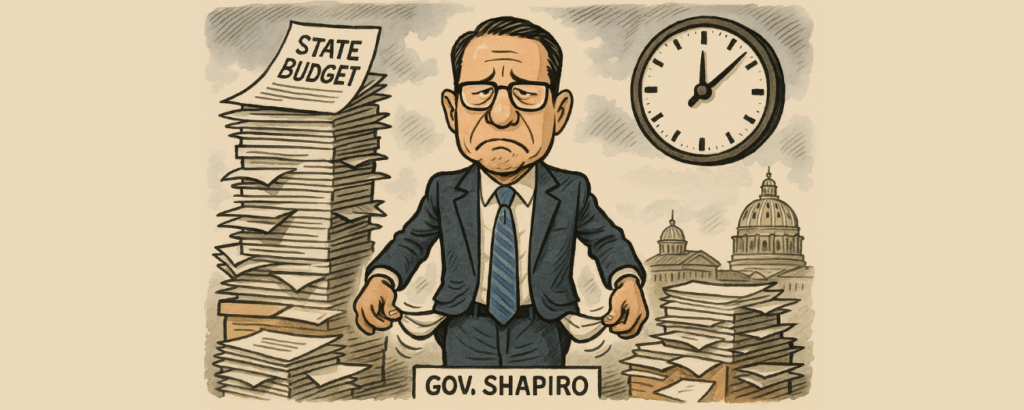
But here in Pennsylvania, the budget deadlines are fake. Even the real ones, like the SEPTA funding, are kind of fake — SEPTA has reserve funds, but they’d rather make commuters’ lives difficult to prove a point. With no pressure points, what would anyone compromise? We are nearly two months overdue on this budget and there is no sense of urgency, not from the House, the Senate, or the governor.
So we owe it to our state to make a pressure point. No work, no pay. Let’s amend Pennsylvania’s constitution to cut off legislators’ pay — and the governor’s, too, for that matter — when they don’t get the job done on time. Like the reformers who briefly succeeded in cleaning up Philadelphia’s government, we must demand real constitutional change to clean up the continual mess in Harrisburg.
Kyle Sammin is the managing editor of Broad + Liberty.