
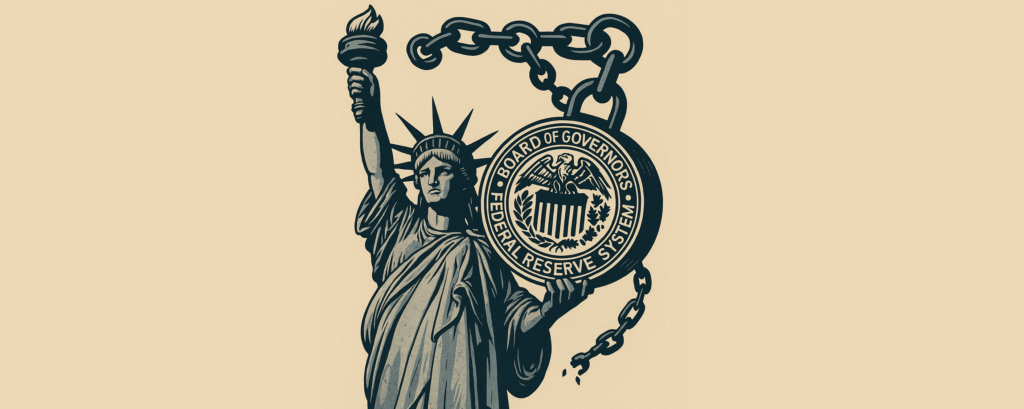
Restoring economic freedom requires a new Fed strategy
Once again, the Federal Reserve is holding interest rates steady. What a mistake.
Our nation is facing a perfect financial storm that will affect the lives of our citizens for decades to come. Not since World War II, has an economy, such as in the United States, had to transition so dramatically.
After World War II, the U.S. moved from a wartime footing to a peacetime, private sector-controlled economy. Europe benefited from the Marshall Plan which included very generous protections in terms of tariffs for Europe and the rest of the world at the expense of U.S. businesses. President Trump is successfully restoring that balance, almost 35 years after prior administrations should have restored free trade and tariff balance.
In 2025, the United States is once again in a massive transition from a government sector-controlled economy to a private sector-controlled economy. The U.S. economy with its $37 trillion in debt is strategically vulnerable to economic disaster. The ongoing deficits and high interest rates will only exacerbate the problem. We cannot, as a nation, continue to function, as we have since Bill Clinton and Newt Gingrich last balanced the budget.
Unfortunately, unlike at the end of World War II, the Federal Reserve is operating contrary to rational economic policy.
Monetary policy and fiscal policy must be consistently applied, or the economic outcomes will be unpredictable.
The Federal Reserve has been asking the wrong questions since 2008. They are solving the wrong problem.
Instead of trying to control inflation, the Fed should be asking why inflation is so low in light of record amounts of funding provided into the marketplace. Inflation, under normal economic models, should have been out of control, even worse than the nine percent high during the early part of the Biden Administration.
With $2 trillion annual deficits, a complete Covid shutdown of the economy, supply chain disruptions, regulatory overreach for business development, and inflation should have been higher than fifteen percent annually. The fact that inflation, while horrible, is not even worse should warn all at the Federal Reserve of the dangers of a deflationary spiral.
Quantitative easing for over ten years is still being unwound. The Federal Reserve balance sheet is a disaster.
None of these scenarios foster an environment for an economic transition to the private sector. It is critical that if this transition is not made, the U. S. will not survive a sustained economic attack such as from the BRIC nations or any other forces that may come to pass.
One only needs to look at the impact that OPEC had in the early 1970’s when the U. S. became economically dependent upon OPEC for fueling our economy. The results included long gas lines, record high interest rates and unsustainable inflation.
At present, the transition back to the private sector is the only viable solution for the long term survival of our nation.
Fortunately, we have a President who understands the magnitude of the problem. Fiscal policy is starting to come under control although we have a very long way to go to turn the corner. DOGE is a step in the right direction.
The Federal Reserve, on the other hand, is unraveling the President’s plans with an unworkable policy towards interest rates.
Rates must come down immediately so that businesses can access the financial capital necessary to cost effectively manage the transition of our economy.
So far, the Fed has missed virtually every form of interest rate guidance that they have provided. Had a CEO of a publicly traded company missed the mark so often, the SEC would have interceded long ago.
Rather than monetary policy helping our economy, it is entirely possible that rational theories of monetary policy may have negative effects when irrationally applied. Deflationary pressures exist and the Federal Reserve is leading us right into that deflationary trap.
In my years in the U. S. Marine Corps Reserve as the Commanding Officer of the Civil Affairs unit and with an expertise in economic warfare, I never imagined that the Federal Reserve would be operating to the detriment of our economy and our people. Once a deflationary spiral starts, it is virtually impossible to stop.
Deflation has devastating effects in every aspect of life. It destroys lives, opportunities, and hope of our great citizens.
The time to act is now. Alan Greenspan’s “The Age of Turbulence” will look calm in retrospect should the Federal Reserve not act now to reduce interest rates and facilitate the transition to a peace time and private sector-controlled economy.
Should the Fed fail to act, they will have caused an economic depression and deflationary spiral unlike anything we have ever seen.
Col. Frank Ryan, CPA, USMCR (Ret) and served in Iraq and briefly in Afghanistan and specializes in corporate restructuring and lectures on ethics for the state CPA societies. He has served on numerous boards of publicly traded and non-profit organizations. He can be reached at FRYAN1951@aol.com and twitter at @fryan1951.


Mr. Ryan,
Good article. Japan’s “Lost Decades” —stagnation, delayed spending—but it also showed that life goes on. Hope isn’t inherently crushed; people adapt, and economies adjust.
Does Pennsylvania require mandatory lectures/ classes for township leaders regarding fiscal planning? It seems Pennsylvanians are facing many little ticking timebombs within their budgets all across our various Townships. For example: Upper Darby School District previously offered $2mm for the DelCo Memorial Hospital. Now they’re at $600k. The Seller still owes roughly $19.74mm in back property taxes for that site. Not sure what the solution there might be; but where else are there potential problems and how can our leaders get out in front of them in advance?
I will comment as a former township supervisor. In my experience, a large proportion of people who run for office as a township supervisor are not doing so as a public service. They are looking for an edge of some kind or the other or some other tangible benefit. It certainly isn’t for the $50 per month pay for second class township supervisors. The work involved in the operation of the township is pretty much equivalent to running a complex business. Personally, I was retired and very motivated, so I put in the time. For those still working, supervisor duties took a lot of their free time, and they had to depend a great deal on the township staff. The Association of Township Supervisors offered seminars and classes in management of and financial management for First- and Second-Class townships. Again, for those who worked, it was difficult to near impossible to attend the classes. Again, requiring their need to rely on the staff.
At this time, I want to vent about the complex issues faced by the supervisors. The blizzard of lawyer, engineering firms and consultants could be overwhelming. (You had to learn how to distinguish good advice from the lightly polished pieces of poop some were trying to sell). The requirements of federal law, state law and regulation absolutely require the review and analysis of the previously mention professionals. Unfortunately, the issue that ends up as the bottom priority is financial management. For a great deal of supervisors, not having to increase or establish new taxes in any given year is all they need to know about finance, how the township gets there, and its consequences are a can kick down the road. I do want to point out that the really rural townships in the Northern Tier often have the supervisors as township employees. Often a supervisor will be appointed as the road master. Minimal employees are the norm as the tax base is small, and the residents can’t really afford much of a tax burden. In my judgement, the real danger is those who are using the supervisor office as a launch to a political career and only care about township finances to the degree they can fund any programs, needed or not, the supervisors think will advance their political career.
We have a Federal Reserve Bank with contradictory mandates. Sort of like Dr. Doolittle’s Push Me-Pull You. All this because early 20th century “progressives” did not want JPMorgan bailing out the economy during the 1906 recession. (A happy side to the establishment of the federal reserve system was Congress no longer had to apply fiscal discipline to government spending. Now just sell deficits to the Fed). We are stuck with the consequences of two 20th century catastrophic blunders: The Fed not cutting interest rates during the Great Depression. and Nixon taking us off gold and moving to pure fiat money. (Congress loved it, though,),